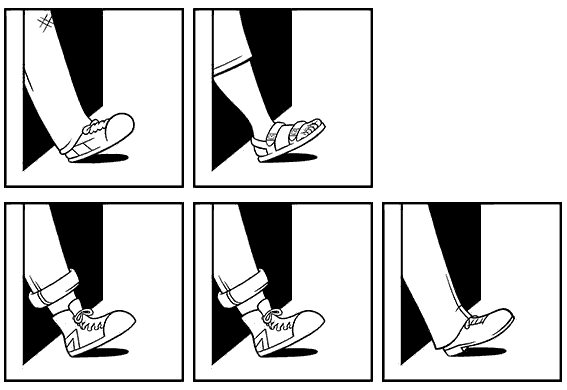
Stepping Across the Threshold: Learning to Say Black Lives Matter is an online collection of personal stories encouraging mainly white people to take a stand for racial justice.
We invite people who have followed their consciences across the threshold into the larger human community by becoming publicly visible for racial justice, to share their experience. The idea is for the stories to touch other white people who are re-evaluating their thinking in regard to race, and who could use inspiration, modeling and encouragement to act.
We particularly invite white people because we are the least represented element in the coalition necessary to move our nation toward racial and economic justice, but we need and welcome stories from everyone who has come to terms with the necessity of speaking out and acting against racial discrimination and violence.
Our stories are best told with humility, with respect for the reader, and with an unspoken appeal to the reader to take our story to heart. The purpose is to build community, to bring others with us as we move into more visible action for justice. Writing and publishing our story, and then telling others we’ve done so, is one way of normalizing visible white opposition to white privilege. It has to become the expected thing that whites will work to end systemic racism.
It’s natural that people are deeply attached to their family and culture, but when one’s culture is dead-set on the exclusion of other people, or on its own unrecognized superiority, that’s a problem. White people are sometimes unable to conceive of going against their culture, whether it manifests the less obvious forms of superiority and racism, or more overt forms. This project says it can be done, it can be done in love, it can be survived, and there is life more rewarding on the other side of the threshold. There is risk involved, there may be loss, but there is also new community, a trodden path, and a way forward.
We ask that stories touch on these points (when applicable):
- How you moved from point a to point b in how you think about, or relate to, the issue of race
- What it cost you to take action for racial justice, what you lost
- What you gained in doing so, how you were changed
We organize the project and write our stories with two caveats.
- We are on guard against self-congratulation, knowing that we have not arrived at a destination — in this culture, we must always be on guard against the influences of racism. We are merely on a journey in which we invite others to join us.
- We keep in mind that the stories of white people stepping across the threshold, while important and needing to be told, are but one aspect, and not the central one, of the vast story of the struggle for human rights by and for people of color. The participation of people of color as we develop the project, and the inclusion of stories by people of color as we publish, are key. We work in a spirit of solidarity with local Black leaders who organize in support of Black lives.
Resources that have been used in preparation for starting the project include
- The United Church of Christ curriculum, White Privilege: Let’s Talk — especially the sections that deal with writing a Spiritual Autobiography Through the Lens of Race
- But Now I See: The White Southern Racial Conversion Narrative, by Fred Hobson
- The Wall Between, by Anne Braden
Stories we receive will be assigned an editor who will work with the writer on any needed editing. The writer’s preference will be followed in publishing with the writer’s full name, first name and city only, or name withheld.
Please see the Writing Guidelines page for more information about the editing and publishing process.
We invite and encourage you to send us your story. We look forward to hearing from you.
 The Threshold Project