by Judy Hand-Truitt, Birmingham, Alabama
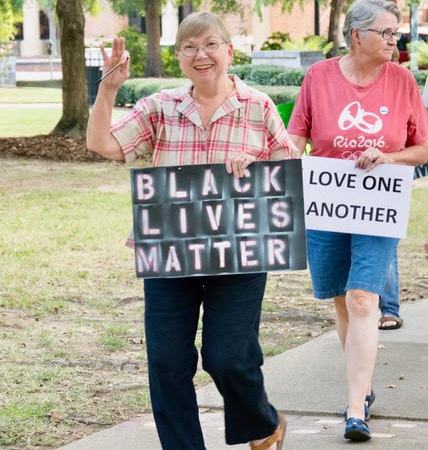
I am a Southern white working-class woman, and I was a worried child.
For all my young life, I’d been told that it was possible that God would send me to hell when I died. The first time I embarrassed my parents was when I insisted, at age 10, on being baptized even though I had already been baptized at age 6. I wanted to do it again because I was tormented with worry that I hadn’t believed correctly the first time. After I was baptized the second time I still wasn’t sure but said nothing about it.
When I was eleven and in the sixth grade, I found a child’s biography of Harriet Tubman in my school’s library. I think that the book may have been placed in the wrong school. It was 1959 in segregated Alabama, and it may have been intended for a Black school but somehow got mis-routed. I read it and even gave a book report on it, but though the violence against the child Harriet shocked me to my core, the meaning and import of her life escaped me. I kept waiting for the writer to explain why it was wrong for Harriet Tubman to have gone against the authorities of her day. No such explanation was given, and I was left with the impossible idea that those authorities, which I intuited were the same ones still in place in my world, could not be trusted.
In the summer of 1963, when I was fifteen, the Southern Baptist church I was raised in, in a rural community south of Bessemer, voted to call the police if a delegation of Black worshipers came to the church seeking entrance. I remember how alone I felt on the ride home, knowing that my parents in the front seat had no idea how far the church had fallen that night in my eyes.
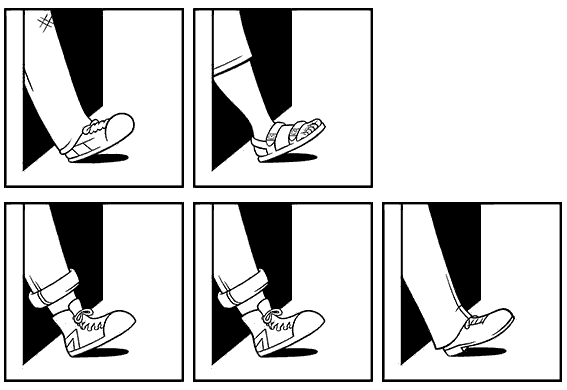
I watched from a distance as the leaders and foot soldiers of the civil rights movement stood up, taking their dignity and demanding their rights. I saw the people deciding for themselves what was legitimate and illegitimate authority, what they would and would not comply with. I remembered the story of Harriet Tubman’s life and began to put the pieces together. The Black freedom struggle created a bridge for me to walk across some years later, freeing myself from restrictive religion and exclusionary politics.
In 1976 I became the first staff person for the Southern Organizing Committee for Economic and Social Justice, and worked until the mid-’90’s with Anne Braden, Rev. Fred Shuttlesworth, Modjeska Simkins, Jim Dombrowski, Rev. Abraham L. Woods, Jr., Rita Anthony, Ron Chisom, Scott Douglas, and many other activists and leaders of the Southern freedom movement, on local and regional issues of civil rights, labor rights, equality in education, police brutality, injustice in the courts, and environmental racism.
My responding to the inner call I heard to take a stand for racial justice led to property violence, personal threats, and loss of employment for me and my immediate family, and to periods of ostracism from my family of origin. The early years were difficult ones, and my relationships with my family are affected to this day.
What I gained, though, is that I became a different person than I would have been. I gained the joy of knowing myself to be an integral part of the whole human family, I gained the ability to see the world through another’s point of view, and I gained independence of thought and action. I also found myself living with the meaning, motivation, and community that I needed to sustain me for my lifetime.
I owe an enormous debt of gratitude to the Black liberation movement. The freedom that followed my signing on without equivocation to the human rights movement unfolding in my lifetime in my part of the world, led to my discovery of spiritual and intellectual truths that I would have been too closed to comprehend had I remained in a fundamentalist or liberal mindset. I have even been blessed to recover the power and beauty of the religious faith that was given to me in such a narrow form at my birth.
I am not innocent when it comes to race. When I was in the tenth grade, I found a way to make a positive reference to George Wallace’s stand in the schoolhouse door in an effort to garner votes when I ran for chaplain of the student council. When I take the online association test for racism, I score in the “automatic preference for White people over Black people” category. I am deeply affected by the racism of this society, and have to be vigilant in plucking up the sprouts that continuously appear within me and around me. Admitting that I am not free of racism is part and parcel of my work to help eliminate it.
In exercising our commitment to anti-racism, it’s our responsibility as white people to unlearn attitudes we’ve lived with all our lives and to not be thin-skinned while we do it. Committing ourselves to the struggle for racial equality requires willingness to be taught and to follow. We must strive to remain malleable and non-defensive in regard to race.
It’s important for white people to understand that when we participate in racial justice work, we do it for ourselves first and not primarily for others. Only in knowing to a certainty that our own lives and those of our children and grandchildren depend on ending racism, will whites make the lifelong commitment needed to help bring about this forward leap in human history. As long as we comply with racism, we are making impossible the coalition required for ensuring equal rights for all and protecting the planet for the future.
It takes more than knowing in our hearts that racism is wrong, and more than saying so in our safest spaces. Being visible and vocal against racism in all aspects of our lives, is what is required at this time.
Racism is not the only issue that keeps us from achieving the quality of life we would like to see for our children’s futures. All the excuses that the powerful use in their relentless efforts to foment exclusion and division — differences in religion, age, gender identity, sexual orientation, physical and mental ability, national identity, citizenship status, housing status, carceral status — have affected all of us, in both how we are treated and how we treat others. We each have our own constellation of injuries and transgressions that we are recovering from. The reason I see racism as key is that its crimes — slavery, lynching, segregation, impoverishment, police abuse, mass incarceration — are so obvious and egregious, and that when people who have been held at the bottom gain more room to maneuver, the whole structure of oppression begins to give way. I want to do my part to help make that happen.
This still can be a beautiful world, if we decide together to make it so.
 The Threshold Project