by Marti Webb Slay, Birmingham, Alabama
It was the first time I had ever seen anyone transformed by hate. I was in the fifth grade. Christmas was approaching, which in Pinellas County, Florida, meant we had traded our shorts for jeans, but the front door was open.
When the doorbell rang, I saw a neighbor, the father of a friend I played with regularly. To my knowledge, he had never come to our house before, yet he smiled at me kindly as I approached, and asked to see my father. He did not come inside when I opened the screen door, so I let it close and turned around, nearly running into my dad, who had come up behind me.
“Can I help you?” Daddy asked.
When I glanced back, I saw this man’s “kindly” smile turn into a twisted, angry expression as he growled hatefully, “Is it true? Are you gonna let those ni***rs live here?”
As long as I live, I’ll never forget the calm, measured, Atticus-like tone of my dad’s response as he nodded thoughtfully: “I was planning to, yes.”
I didn’t hear any more of the exchange, because I walked to the back of the house, where Mom was changing the sheets on the bed, and I asked her if we were still going to let the black family rent our house for the next six months, when it was clearly a problem for our neighbors.
“Would it be right for us to refuse to let them rent the house just because of the color of their skin?” she asked me. Her question clarified the morality of the situation for me immediately. Our neighbors were never neighborly to us again, but I understood we were firmly on the side of justice.
Which is not to say I didn’t have a long road to travel in understanding racism in our society and in myself.
But first, a little background.
I was born in Cincinnati, Ohio, but a beloved uncle would always tell me that my parents (both Florida natives) just happened to be living in Ohio when I was born. He bemoaned the fact that my brother and I came back to Florida “talking like a couple of Yankees.”
We moved to Florida before I turned six. I later lived in Virginia, Atlanta and Birmingham, and my “Yankee accent” is now long gone.
It was always interesting to me that he would insist on proclaiming my southern roots on my behalf. He was no apologist for the Confederacy, but we once visited Stone Mountain together, and when I commented that it was an awful lot of money and work to spend on people who had been wrong, he smiled rather sadly and replied, “You can’t blame someone for being a man of his time.”
We never finished that discussion, but I realized later I COULD blame someone for being a person of his or her time. Because I knew several people who had broken out of those constraints. They had everyone paid a price for doing so, and they were the role models for my life.
The first one was my father. An avid Old Testament scholar, he and my mother decided that he would forego his completion of a PhD and become a pastor in order to support our family. We lived in Ohio, and he was a pastor of several small American Baptist churches over the first six years of my life. I was unaware of the reason at the time, but he changed pastorates and we moved around the state to three different churches over that six years, because in Ohio during the late 50s, a prophetic white pastor speaking on issues of race was not welcomed. My mother once told me that Daddy preached a sermon on the House UnAmerican Activities Committee, and the John Birch Society was waiting for him on the church steps when he unlocked the door the next Monday. In August 1963, he participated in the March on Washington and heard Dr. King give his “I have a dream” speech.
Finally he decided that the pastorate was not his calling after all, and we moved “back” to Florida where he began his career in social work. When I was in the fifth grade, he had an opportunity to pursue a degree in a six-month program in Boston. He and my mother, unwilling to be separated for that length of time, decided to rent our home and move the family to Boston. Changing schools mid-year and moving to a different part of the country may seem like a drastic upheaval, but it turned out to be a grand adventure and a time I remember with many warm memories.
Those memories, however, were marred by events before and after the temporary move, because the family we found to rent our home in a white Florida neighborhood in 1968 was black. The parents were teachers and building a new home, and due to delays in the building process (delays that were clearly because of their race), they needed a temporary home. It would have been ideal…people needing a place to stay over the same period of time that we needed someone to stay in our home…but for our neighbors.
They realized the family that would temporarily be living in our home was black, and their demeanor immediately changed toward us. By the time my friend’s father came to the door, we had already heard from several other people who lived on our street. The mass hysteria over their property values because of whom we were renting to for six months was apparent even to my young, naïve eyes. I didn’t understand it then. I don’t understand it now. There were no major incidents towards the family who rented our house, and we returned to live there for many more years, but only one person on our end of the street ever acknowledged us or spoke to us again.
That eye-opening experience taught me a great deal about racism and began to shape me into the social justice advocate I became. But it was many years before I learned the experience in the fifth grade really wasn’t about me. I saw, but I didn’t understand.
Fast forward ten years.
I was in Birmingham and actively involved in social justice work. A black woman who knew me challenged me about being racist, and I was deeply hurt. How could she? She knew me. I thought we were friends. I felt wronged and shamed and defensive.
At that point, another friend offered me a gift of grace. “Marti,” he said. “We live in a culture that is steeped in racism. It’s raining down on us everywhere. It’s crazy to think that you are standing out in all that and not getting wet.”
When I got past my hurt feelings, I realized he was right, and the shame I felt should not necessarily be for being racist. That was a result of my upbringing, regardless of my parents teaching me otherwise.
The source of shame should be not recognizing my privilege, in thinking my work against racism somehow made me special and immune. The shame lay in not acknowledging my racism and not seeking to eliminate it to every degree possible.
Just as when I was 11 years old, this wasn’t about me, as much as it was about my response to being made aware of racism. I saw, and I slowly began to understand.
Many years later I was a part of starting an intentionally multicultural, multiracial church in downtown Birmingham. Our pastor led us in studies and discussions that helped us learn how to participate in a diverse community in ways that respected and included everyone. Like my father, he is not a man of his time, but chose instead to be a leader and a prophet. He calls himself a recovering racist, and together we have worked on our recovery in a loving and committed and conscious effort to grow beyond our culture.
Also like my father, he paid a deep price for being a fearless prophet, and he was eventually removed from the church by denominational “leaders.” As part of the church leadership, I, too, was removed. I was no longer able to hold a leadership position in a church I helped start and gave my life to for 18 years. Despite a valiant struggle for justice for our pastors and our church, we failed. It was one of the most devastating losses of my life.
But the experience wasn’t only about loss. I gained friends who struggled for justice with me. It took years, but I finally found another diverse church community who supports me and teaches me in my ongoing effort to recover from growing up in the context of systemic racism. I have a community, through my church and beyond, that challenges me with a loving spirit to make me better than I am. I am learning to listen to my black friends and local leaders more than I speak. When I find myself reacting negatively to their guidance and views, I try to check myself and examine why.
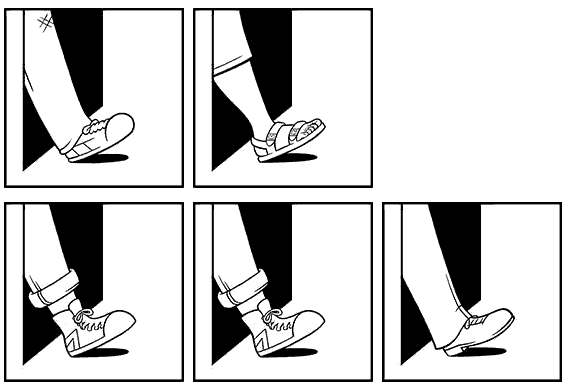
I know now that it is my responsibility to shed myself of racism as much as possible, and that the process will never be over. In that way, fighting racism is about me. I also know that I am called to address systemic racism in all its forms whenever it rears its ugly head, even as I strive to work on myself. Mostly I’ve learned how very much I still have to learn, and how very much we all still have to do to fight the systems and powers that strive to keep us apart. It starts by stepping across the threshold and embracing the idea of a just world.
 The Threshold Project